Gravel Calculator: Coverage, Tons, and Cost Made Easy.
How a gravel calculator turns area and depth into cubic yards, tons, and cost: the formula, real density figures, and a worked example.
- Published
- Sep 14, 2026
- Last updated
- Sep 14, 2026
- Read time
- 7 minutes
- Author
- Muhammad Asif Zaheer
- Gravel suppliers sell by the ton; you measure your yard in feet. A gravel calculator closes that gap: cubic yards = (area in sq ft × depth in inches) ÷ 324, then tons = cubic yards × density.
- Density is the input most bare-result calculators skip. Pea gravel, crushed stone, and river rock weigh meaningfully different amounts per cubic yard, and gravel is sold by weight, not volume.
- Add roughly 10% to the calculated volume before ordering, to cover compaction and normal waste; 15-20% on sloped ground or soft subsoil.
- Depth depends on what you're building: 2-3 inches for a decorative bed, 3-4 for a patio or path, at least 4 for a driveway's surface layer.
The gap between feet and tons
Gravel suppliers sell by the ton. You measure your yard in feet. That mismatch is exactly where homeowners either overpay by ordering too much, or end up paying for a second delivery because they ran short. A gravel calculator closes that gap: enter area, depth, and gravel type, and it returns cubic yards, tons, and an estimated cost.
Plenty of online estimators just hand you a number with no explanation. You can’t tell whether it accounts for density, and you can’t check the math before calling your supplier. A calculator that shows the formula and a worked example alongside the result lets you verify it yourself before you open your wallet. That’s the approach this article walks through, in plain English, and the same approach every calculator on Calculator Planet takes: show the formula, not just the number.
What you enter into a gravel calculator
Measuring your area
For a rectangular space, area is length times width in feet: a 20-by-25-foot driveway apron is 500 square feet. An L-shaped driveway or a curved bed gets handled by splitting the space into smaller rectangles, calculating each one, and adding the totals. A driveway that’s 12 by 30 feet with a 10 by 15 foot pad attached is 360 plus 150, or 510 square feet total, not an averaged estimate across the whole shape.
Sloped ground adds a wrinkle most people miss: gravel covers the actual ground surface, not the flat footprint you’d see from directly above. On a noticeable grade, run the tape along the slope itself rather than sighting a level line across the top, or the calculation will undercount the area.
Choosing the right depth
Depth is entered in inches, and it drives the entire estimate more than the area does. A shallow 2-inch layer suits a decorative bed but won’t survive vehicle traffic; a driveway needs substantially more to stay stable under load. Getting the depth wrong doesn’t just shift the number: it means the finished surface either washes away or ends up costing far more to fix later than it would have to order correctly the first time.
Selecting gravel type
The gravel type tells the calculator which density to use when converting volume to weight. Pea gravel, crushed stone, and river rock weigh meaningfully different amounts per cubic yard, and suppliers charge by the ton, so without a real density figure, the ton estimate is just a guess. Getting this input right is the difference between an accurate order and an expensive overage.
How a gravel calculator converts square feet to cubic yards
Every aggregate calculator runs the same core formula:
The 324 comes from 12 (inches per foot) multiplied by 27 (cubic feet per cubic yard): you’re converting depth from inches to feet, getting the volume in cubic feet, and dividing by 27 to reach cubic yards, all in one step. It’s exactly the formula CalculatorPlanet’s own gravel calculator runs, just written as one division instead of two steps.
Coverage quick reference
One cubic yard of gravel covers a different area depending on how deep you spread it:
| Depth | Coverage per cubic yard |
|---|---|
| 2 inches | 162 sq ft |
| 3 inches | 108 sq ft |
| 4 inches | 81 sq ft |
| 6 inches | 54 sq ft |
Run that relationship in reverse and you have the depth-based logic most gravel estimators use under the hood.
Worked example
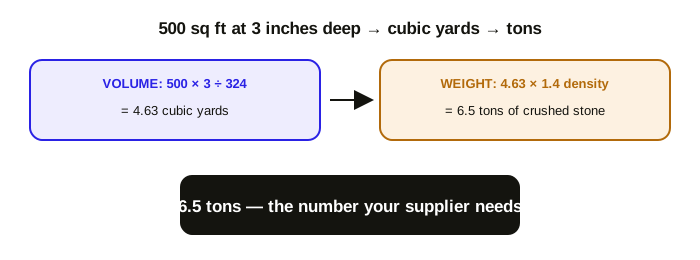
Take a 500 square foot area at 3 inches deep. Multiply 500 by 3 to get 1,500, then divide by 324: 4.63 cubic yards. Change the depth to 4 inches on the same 500 square feet and it’s 500 × 4 ÷ 324 = 6.17 cubic yards. One extra inch of depth adds more than a full cubic yard on a project this size, which adds up fast once you’re pricing crushed stone by the ton.
Converting cubic yards to tons
Gravel is sold by weight, not volume, so converting cubic yards to tons means multiplying by the material’s density. A typical planning range runs 1.2 to 1.7 tons per cubic yard. Using a generic figure when your material sits at either end of that range can throw the order off meaningfully: on a 10-cubic-yard project, the difference between 1.2 and 1.7 tons per cubic yard works out to a 5-ton swing, which matters both on the invoice and in how the finished surface performs.
| Material | Density (tons per cubic yard) |
|---|---|
| Pea gravel | ≈ 1.3 |
| Crushed stone | 1.4 – 1.5 |
| River rock | 1.3 – 1.4 |
The conversion is tons = cubic yards × density. Taking the 4.63-cubic-yard result from above and applying a crushed stone density of 1.4: 4.63 × 1.4 = 6.5 tons, the number you’d actually give a supplier when placing the order.
A calculator that hides this conversion leaves you unable to check or question the number on your quote. Showing both steps, with a worked example, is exactly the approach behind CalculatorPlanet’s gravel calculator: enter your own area, depth, density, and price per ton, and it returns tons, cubic yards, and total cost together, with the formula shown alongside.
How much gravel your project actually needs
Driveways
Driveways need the most material, since they carry vehicle weight and compact over time. A standard residential driveway needs at least 4 inches of crushed stone for its surface layer, and many contractors recommend 6 inches on soft subsoil or for regular use. Crushed stone is the right material here: its angular edges interlock and resist shifting far better than rounded river rock or pea gravel. Run the formula at both 4 and 6 inches to get a planning range, then confirm the depth with a contractor once you know your subsoil.
For driveway projects specifically, the stone calculator carries density and coverage defaults tuned to crushed stone rather than gravel’s broader range, which is worth using once crushed stone is specifically what’s going down.
Garden beds and landscaping
Decorative gravel performs well at 2 to 3 inches. At 2 inches, one cubic yard covers 162 square feet, which scales easily from any bed size. River rock and pea gravel are the common choices here, and both sit near the lighter end of the density range, so the ton estimate comes in lower than a crushed stone driveway job of the same volume. If the goal is purely aesthetic (a dry creek bed, a border, ground cover), don’t over-order by defaulting to a driveway-style depth; the river rock calculator is built specifically around that decorative use case.
Patios and pathways
Patios benefit from 3 to 4 inches of compacted crushed stone for a surface that won’t shift underfoot. Irregular pathway shapes are easiest handled by breaking the path into rectangular segments, running the formula on each, and summing the results, which keeps the math simple and avoids the errors that come from trying to approximate a curved shape as one calculation.
Waste allowance, cost, and the most common ordering mistake
The 10% buffer rule
Add 10% to the calculated cubic yard total before placing an order. That covers compaction (gravel settles after installation), minor measurement error, and material lost during delivery and spreading. On sloped ground, irregular borders, or soft subsoil, push the buffer to 15 or 20%.
≈ $20
What bulk gravel costs
Bulk crushed stone typically runs $25 to $60 per cubic yard, or $20 to $50 per ton, at retail in the U.S.; general landscaping gravel spans $15 to $75 per ton depending on type and region; pea gravel tends to run somewhat higher, often $25 to $55 per ton for bulk material. These are general planning ranges, not a quote: hauling distance and local quarry proximity shift prices meaningfully, so a real local quote is essential before ordering.
Delivery fees and the all-in total
Most residential gravel deliveries run $50 to $150 per load, regardless of quantity, a flat fee that changes the effective per-yard cost dramatically on small orders. A single cubic yard of crushed stone priced at $40 becomes $90 to $190 delivered once that flat fee is added, which is worth knowing before deciding whether picking up bags from a home-improvement store beats a bulk delivery for a small job. On larger projects, spreading that same delivery fee across more yards brings the effective per-yard cost down quickly.
Bagged material can win on total cost
Bagged gravel runs far higher per ton than bulk, but a flat $50-150 delivery fee on a tiny bulk order can make bags from a hardware store the cheaper option once that fee is factored in.
Bulk delivery wins decisively
Spread across enough yards, the flat delivery fee stops mattering and bulk material’s much lower per-ton price takes over. This is where the gravel calculator’s cost output is worth comparing against a real supplier quote.
The gravel calculator above already models this: enter your own price per ton and it returns a total cost alongside the tonnage, so you can run a couple of quantity or material scenarios before committing to an order size.
Before you call your supplier
Measure the area, choose the depth for your project type, then convert volume to weight using the right density for your material. Add a 10% buffer, and pull a current local price before finalizing. The whole calculation takes under two minutes once you have your measurements: the cubic yards formula alone takes about 30 seconds by hand, and the tons conversion adds one more multiplication.
Whether it’s pea gravel for a garden bed or crushed stone for a driveway base, understanding these two formulas means you can check any supplier quote yourself, catch an error before it costs you, and order exactly what the project needs the first time. If crushed stone or river rock is specifically your material, the stone calculator and river rock calculator carry density and coverage defaults built around those materials rather than gravel’s wider range; otherwise, the gravel calculator above covers the general case with the formula and a worked example shown on the same page, free and with no account required.
Frequently asked questions
How do I calculate how much gravel I need?
Multiply the area you're covering, in square feet, by the depth in inches, then divide by 324: that gives cubic yards. Multiply by your material's density (about 1.3 to 1.7 tons per cubic yard, depending on type) to get tons, the unit most suppliers actually sell by. A 500 square foot area at 3 inches works out to 4.63 cubic yards.
Why does gravel type change the tonnage estimate?
Gravel is sold by weight, and different materials pack differently. Pea gravel runs around 1.3 tons per cubic yard, crushed stone about 1.4 to 1.5, and river rock roughly 1.3 to 1.4. On a 10-cubic-yard project, using 1.2 instead of 1.7 tons per cubic yard changes the order by 5 tons, enough to matter on the invoice and in how well the finished surface holds up.
How much extra gravel should I order for waste?
Add about 10% to your calculated cubic yard total to cover compaction, minor measurement error, and material lost during delivery and spreading. Push that to 15 or 20% on sloped ground, irregular borders, or soft subsoil. The extra material is cheap compared to a second delivery fee if you order short. It's often just a fraction of what a repeat trip costs.
How deep should gravel be for a driveway versus a garden bed?
A residential driveway needs at least 4 inches of crushed stone for its surface layer, and many contractors build to 6 inches on soft subsoil or for regular vehicle use. Crushed stone's angular edges interlock and resist shifting better than rounded materials. Decorative landscape beds only need 2 to 3 inches, since there's no load to support.
Try it yourself
Gravel CalculatorGravel calculator for driveways, paths, and base layers. Enter area and depth to get cubic yards, tons of gravel, and total cost with adjustable density.OpenRelated calculators
- Gravel CalculatorGravel calculator for driveways, paths, and base layers. Enter area and depth to get cubic yards, tons of gravel, and total cost with adjustable density.Open
- Stone CalculatorCrushed stone calculator for driveways and patios. Enter area and depth to get cubic yards, tons, and cost, with adjustable density.Open
- River Rock CalculatorRiver rock calculator for dry creek beds, borders, and decorative beds. Enter area and depth to get cubic yards, tons of river rock, and total cost.Open
Related articles